
Introduction
Does your child constantly skip lines while reading, lose their place on a page, or complain of tired eyes after just a few minutes of schoolwork? As parents and educators, our immediate instinct is often to worry about reading fluency, phonics comprehension, or even a lack of focus. We might try buying phonics flashcards, pushing for more reading time, or worrying that our child simply isn’t interested in books.
But there is a silent, physical hurdle that frequently masquerades as a reading struggle or behavioral distraction. It has nothing to do with phonics rules, vocabulary size, or intelligence. Instead, it is a physical issue of coordination: visual tracking. Just like learning to kick a ball or ride a bike, learning to read requires a sophisticated system of muscle control. The eyes are guided by six external muscles that must move together with micro-millisecond precision. If those muscles haven’t yet built the strength or coordination to slide smoothly across a row of text, reading can quickly become exhausting, frustrating, and physically uncomfortable.
For our children, navigating a page of text in the digital age is harder than ever. Between rapid-fire video cuts and interactive touchscreens, their eyes are trained to jump erratically rather than tracking steadily from left to right. This is why introducing gentle, screen-free visual tracking eye exercises for kids and spiral coordination activities early in child development is one of the most powerful, life-changing gifts we can give them.
What is Visual Tracking and Why Does It Hold the Key to Reading?
In early childhood development, visual tracking is the eye’s ability to follow a moving object or slide smoothly along a stationary path (such as a line of words on a page) without losing focus. In clinical and educational research, visual tracking relies on two primary types of eye movements:
1. Smooth Pursuits: The eyes’ ability to follow a continuously moving target smoothly (like tracking a flying bubble or a rolling toy car).
2. Saccades: The rapid, microscopic jumps the eyes make from one fixed point to another (like jumping from one word to the next in a sentence, or scanning down a column of numbers).
When a child struggles with smooth pursuits or saccadic movements, they don’t see the page the way we do. Words might appear to jumble together, sentences may seem to drift, and their eyes might jump back to the beginning of a line they’ve already read. Over time, this physical strain drains their mental energy. What looks like an attention deficit or a comprehension struggle is actually just physical eye muscle fatigue.
The Bilateral Connection: Linking the Left and Right Brain
To make visual tracking even more efficient, the eyes must coordinate with the brain’s hemispheres. This is where bilateral coordination—the ability to use both sides of the body together in a controlled, unified way—plays a vital role. In cognitive training, activities that require children to cross their physical body’s “midline” or perform coordinated movements with both hands simultaneously (known as bilateral integration) strengthen the corpus callosum. This is the neural bridge that connects the left and right hemispheres of the brain.
When a child practices bilateral brain games, they are building faster, more resilient neural path connections. This neural speed directly supports visual-spatial awareness, hand-eye coordination, and visual focus, making the physical act of tracking words from left to right feel natural and effortless.
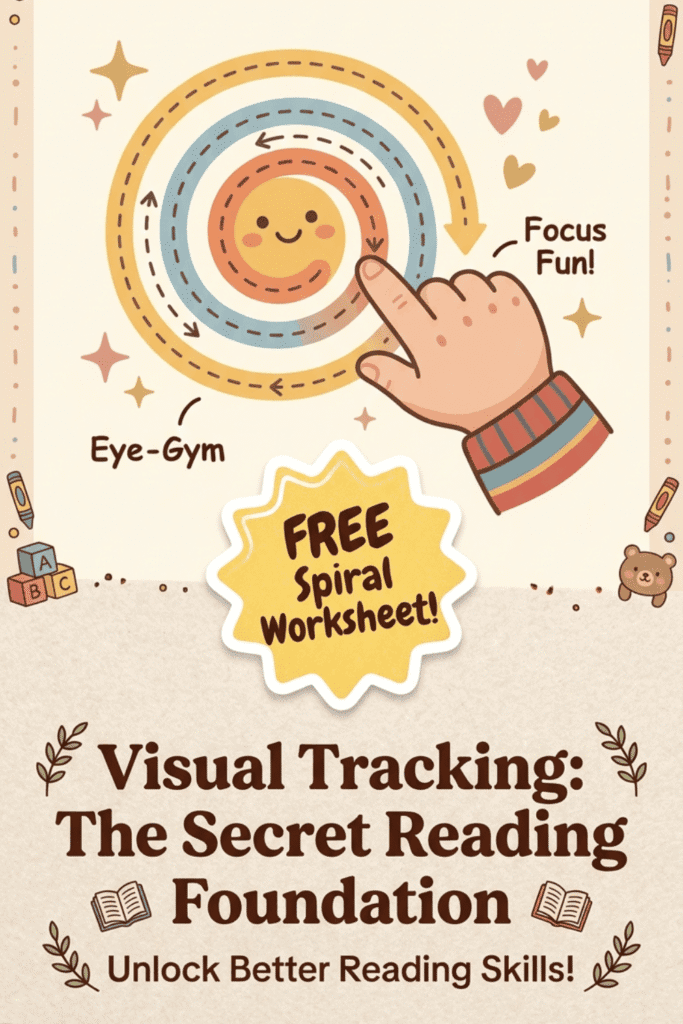
Free Spiral Visual Tracking Practice Worksheet!
Train smooth pursuit tracking movements, visual concentration, and spatial focus with our engaging spiral eye-gym tracing sheet! Download our free printable practice page and watch your child’s focus soar.
📥 Download Free Practice Worksheet Now!By downloading our free printable, you agree to our Terms & Conditions of usage.
Simply print the worksheets, have your child hold their head steady, and trace the spiral with their eyes or a finger to build smooth tracking control!
Simple “Lazy Eights” Eye Gym: Zero-Prep Exercises
Before sitting down with structured paper activities, you can start your focus routines with a playful, zero-prep physical exercise called the “Lazy Eights” game. This is a classic visual training exercise used by developmental therapists to cross the body’s visual midline:
1. Set the Stage: Have your child stand or sit comfortably, looking directly ahead at you.
2. Use the Target: Extend your index finger (or hold up a colorful pen or lollipop) directly in front of their nose.
3. Trace the Infinity Loop: Draw a large, lazy “8” or infinity symbol (∞) in the air, moving from the center, sweeping up and around to the left, crossing back through the center, and sweeping up and around to the right.
4. Track Without Turning: Instruct your child to follow your finger or pen strictly with their eyes without turning their head. Keep their chin perfectly still so only their eye muscles do the work!
5. Let Them Try: Once they get the rhythm, have them extend their own arm, make a thumbs-up, and track their own thumb as they draw infinity loops in the air.
This simple exercise stretches the external eye muscles, coordinates smooth pursuit tracking, and forces the brain to process movements smoothly across the visual midline—which is exactly how their eyes must cross the center fold of an open book!
Establish Clear Focus & Hand-Eye Strength with Our Premium Bundle
We know how much research, preparation, and consistency are required to build a daily visual training routine. Between school runs, grading papers, and managing daily routines, busy parents and educators don’t always have the time to research clinical focus exercises or design clean, engaging puzzles.
That is why we have consolidated our most popular, kid-approved visual and cognitive exercises into a single plug-and-play system!
We are thrilled to offer our Ultimate Visual Training & Cognitive Skills Bundle on our Payhip shop for only $29.00! Rebuilt entirely from our most successful, highly rated Etsy designs (with 33 total units sold across our catalog), this bundle is the ultimate, zero-prep toolkit to build your child’s tracking coordination, concentration, and spatial awareness.
Each resource in this bundle is formatted as a ready-to-print, high-resolution PDF, making it incredibly simple to download and print on standard home or classroom printers.
🎓 What is Included in Our Ultimate Visual Training & Cognitive Skills Bundle:
- 👁️ Vision Care Eye Training Charts (Set of 8): Our flagship wall-hanging visual workout charts to improve distance tracking, peripheral coordination, and focus shifting.
- 📖 Visual Tracking Eye Exercises – Focus & Concentration Guide: Step-by-step instructions and daily workout schedules to build smooth, steady left-to-right eye coordination.
- ✏️ Double Doodle Bilateral Brain Game (Complete Mega Bundle): Cross-body bilateral coordination tracking puzzles (32 unique symmetric dual-hand games!).
- 🎯 Dot-to-Dot Visual Tracking Concentration Training: Saccadic eye-jump puzzles to help kids scan lines of text comfortably without losing their place.
- 🔢 Schulte Grid Cognitive Training Challenges: Clinical-style focus grids to widen peripheral vision, expand visual field processing, and speed up reading habits.
- 🧘 Mandala Memory Game Mega Bundle (44 Puzzles): Fun visual memory and pattern recognition card sets to build stellar recall and attention spans.
A4 and up to A2 Sizes • Professional Home-Use Visual Focus Clinic
Frequently Asked Questions (FAQ)
What is the best age to start visual tracking and brain exercises? ▼
How does symmetrical tracing with both hands actually work in the brain? ▼
Are these files editable in Canva like your AI Literacy Kit? ▼
Conclusion
Reading is a gorgeous intellectual journey, but it is built on a physical, developmental foundation of muscle control. By looking beyond simple screen time limits and incorporating playful, screen-free “eye gym” games and Spiral tracking worksheets, you can transform the physical act of tracking words from a chore into a fluent, joyful habit. Take advantage of our free spiral tracing worksheets, build strong developmental routines, and set your young explorers up for a lifetime of confident learning and reading success!
Related Articles: Internet Safety for Kids: Free Printable Emoji Code Decoder Puzzles – Tater Tots Co.
🔐 Unlock The Secret Vault
10 free printables for kids & parents — including our Preschool Preparatory Pack, Homeschool Planner Sample & more!
Join 2,000+ subscribers getting instant access to printable worksheets, planners, and learning resources.
Enter your details — we'll send your vault password instantly!